


Polyester PCB is Ultra-Low-Cost Flex Circuits for Disposable Sensors, Membrane Switches & LED Light-Strips
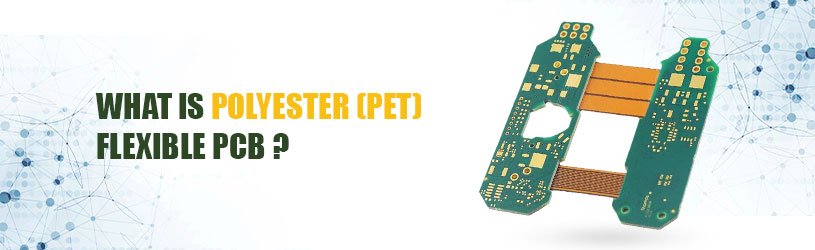
What Is a Polyester PCB?
A polyester PCB—often called PET flex—uses polyethylene-terephthalate film as the dielectric instead of polyimide.
Typical construction:
- Electrodeposited (ED) copper 12 µm or printed silver ink
- PET film 50 – 250 µm (εʀ ≈ 3.2, Df ≈ 0.018)
- Acrylic adhesive (for copper-clad versions)
Because PET softens near 105 °C, PET flex circuits are screen-printed or chemically etched at low temperatures and finished with low-temp Sn-Bi solder, crimp contacts, or conductive adhesive.
highpcb is one of the largest Flex PCB manufacturing company in China, Click on the link for more information.
Why Pick Polyester Over Polyimide?
50 – 60 % lower laminate cost
Ideal for price-sensitive or disposable devices
Transparent & printable
Back-lit keypads, capacitive touch foils, decorative graphics
Roll-to-roll manufacturable
Tens of metres produced per minute → unbeatable unit cost
High tensile elongation (~120 %)
Survives snap-fit assembly without cracking
Excellent dimensional stability
±0.1 mm per metre at 23 °C / 50 % RH—flat key-matrix domes
highpcb is one of the largest Polycarbonate PCB Manufacturing Company in China, Click on the link for more information.

Key Limitations & How to Work Around Them
| Limitation | Mitigation Strategy |
| Reflow-incompatible (Tm ≈ 255 °C, softens > 110 °C) | Use Sn-42 Bi-57 Ag-1 paste @ 175 °C peak; hot-bar, ACF, or crimp terminals |
| Lower peel strength vs. PI | Rough-en copper with micro-etch; use RA copper if space allows |
| Moisture & UV sensitivity | Add PET-based white overlay or UV-block varnish for outdoor use |
| Acrylic adhesive cold-flow | Keep continuous operating temp < 85 °C; use stiffeners under SMT parts |
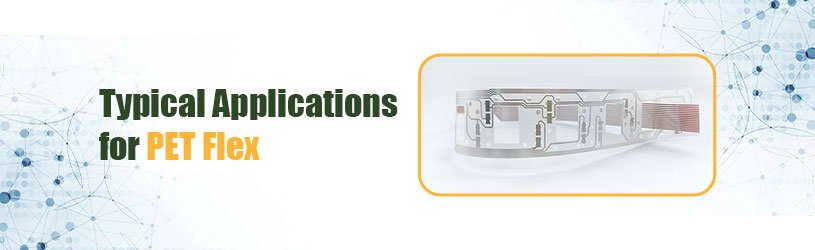
Typical Applications for PET Flex
| Segment | Examples |
| Human–machine interface | Membrane-switch matrices, capacitive slider foils, back-lit touch keys |
| Disposable medical | Blood-glucose test strips, ECG patches, drug-delivery pump inserts |
| LED lighting | Edge-lit acrylic panels, string LEDs for signage, holiday lights |
| RFID & NFC | Antenna inlays for logistics tags, contactless payment cards |
| Low-power sensors | Force-sensing resistors, printed temperature/humidity arrays |
PET Flex Stack-Up Choices
1 Screen-Printed Silver Ink (Single-Conductor Layer)
Protective UV varnish
Printed Ag conductor 8–12 µm
PET film 125 µm (clear)
Adhesive transfer tape (optional)
Backer paper / graphic overlay
Most economical—down to US $0.02 / cm² in volume.
2 Copper-Clad PET (Double-Sided Low-Cost Circuit)
Imm Sn-Bi 2 µm finish
Coverlay: PET 25 µm + PSA
Cu 12 µm — Top tracks
Acrylic adhesive 15 µm
PET core 50 µm
Acrylic adhesive 15 µm
Cu 12 µm — Bottom tracks
Coverlay PET 25 µm
Supports 0.25 mm-pitch ICs & small LEDs.
Manufacturing Flow (Roll-to-Roll & Sheet-Fed)
| Step | Silver-Printed PET | Copper-Clad PET |
| Film clean & corona treat | ✔ | ✔ |
| Conductor formation | Screen print Ag; dry 120 °C × 5 min | Photo-image; etch cupric chloride |
| Die-punch registration holes | ±0.05 mm | ±0.05 mm |
| Coverlay / overlay lamination | UV-curing acrylic | Pressure-sensitive adhesive |
| Kiss-cut / laser-cut outline | Steel-rule die (200 hits/min) | CO₂ laser ±30 µm |
| Low-temp solder / hot-bar / ACF | 175 °C Sn-Bi; 180 °C ACF | 175 °C Sn-Bi; selective-solder mask |
| 100 % E-test | Capacitive or flying-probe | Flying-probe ≤200 pts/s |
Roll-width up to 350 mm; sheet panels 510 × 610 mm available for copper versions.
Design Guidelines for PET Flex
| Feature | Recommended Value |
| Min trace / gap (Ag print) | 200 µm / 200 µm |
| Min trace / gap (Cu etch) | 100 µm / 100 µm |
| Min plated through-hole | Avoid—use jumpers or rivets |
| Static bend radius | ≥ 10 × total thickness |
| Dynamic flexing | Not recommended; choose PI if cycles > 50 k |
| Pad-to-bend distance | ≥ 2 mm |
| Stiffener thickness | FR-4 or PI 0.2–0.3 mm under SMT |
| Current vs. trace width | 500 mA → 1 mm (Cu 12 µm); 200 mA → 1 mm (Ag 10 µm) |
LED strip tip: Use white PET overlay to boost luminous efficiency by > 20 % and protect copper from sulphur tarnish.
Reliability & Test Matrix
| Test | Spec | Typical PET Result |
| Solder dip 180 °C Sn-Bi, 10 s × 3 | IPC-TM-650 2.4.13 | No blister / no pad-lift |
| Static bend 5 × t, 1000 cycles | IEC 60068-2-21 | ΔR < 3 % |
| Humidity 85 °C / 85 % RH, 168 h | IPC-TM-650 2.6.3.5 | ΔR < 5 %, IR > 100 MΩ |
| Adhesive cold-flow @ 85 °C, 100 h | MIL-P-50884 | Edge creep < 0.3 mm |
| UV ageing 500 h | ASTM G154 UV-A | ΔR < 5 %, slight yellowing |
Cost Drivers & Optimisation
| Driver | Cost Impact | Optimisation Tip |
| Roll-to-roll silver thickness ↑ | +US $0.03 / µm per m² | Print 8–10 µm + carbon pad on switch contacts |
| Coverlay laser area ↑ | +US $0.10 / cm² | Gang large windows; use die-cut PSA |
| Double-sided Cu PET | ×1.8 vs single-Ag print | Re-route to single-sided + jumpers if possible |
| Selective stiffener lam. | +US $25 setup | Use kiss-cut FR-4 self-attach stiffeners |
| ENIG on Cu PET | ×1.4 vs Sn-Bi | Choose Imm SnBi or OSP unless gold needed |
Support All Types of PCB Fabrication
Biggest PCB Manufacturers

Why Order Polyester PCBs from HighPCB?
- Dual production lines – roll-to-roll screen printing for high-volume silver circuits & sheet-fed LDI for fine-pitch copper PET.
- Clean-room corona treatment – ensures peel strength > 1.2 N cm⁻¹ even after 85/85 humidity.
- Rapid DFM & cost-down advice – panel utilisation, ink-coverage map, stiffener optimisation in 48 h.
- Fast lead-times: 3-day silver prototypes (1-layer), 7-day Cu PET (double-sided).
- Add-on services: white overlay printing, hot-bar flex-to-rigid attach, Sn-Bi selective wave, 100 % flying-probe & switch-matrix functional test.
Need a flex circuit that hits aggressive cost targets without sacrificing reliability?
Request your instant polyester PCB quotation from HighPCB today—our PET flex specialists will optimise the material, trace geometry, and roll-to-roll process to deliver the lowest total cost for your membrane keypad, disposable sensor, or LED lighting project.
FAQ
Q 1. Can PET flex circuits be autoclaved?
No. PET softens > 110 °C. Use polyimide for steam sterilisation.
Q 2. How small can switch-matrix pitch go on printed silver?
Down to 1.0 mm dome pitch with 200 µm conductor / gap; carbon top-print recommended.
Q 3. Are PET flex boards RoHS-compliant?
Yes—all inks and copper laminates supplied by HighPCB are RoHS 2 & REACH compliant.
Q 4. Maximum roll length for silver-printed PET?
Up to 100 metres continuous at 250 mm width.