


Cost-Optimised Rigid Boards and CEM PCB 1 (Single-Layer PCB) for Home Appliances, LED Drivers & General Electronics

What Is a CEM-1 PCB?
CEM-1 (Composite Epoxy Material, type 1) is a hybrid laminate consisting of:
- Woven-glass cloth on the copper side (for dimensional stability)
- Cellulose paper core (for punchability and low cost)
- Epoxy resin system bonding the layers
Because CEM-1 is glass-reinforced on only one face, it bridges the gap between full FR-4 (all-glass) and phenolic (all-paper) substrates, delivering moderate mechanical strength at roughly 70 % of FR-4 cost.
| Property | Typical Value* | Design Impact |
| Dielectric constant (εr, 1 MHz) | ≈ 4.5 | Impedance control to ~100 MHz is feasible |
| Loss tangent (1 MHz) | 0.02 | Acceptable for low-to-mid-frequency digital/analog |
| Glass-transition temperature (Tg) | ~110 °C | Survives tin-lead wave solder; marginal for Pb-free reflow |
| Coefficient of thermal expansion (Z) | 70–85 ppm / °C | Slightly higher than FR-4; manage via aspect-ratio ≤ 6 : 1 |
| Thermal conductivity | 0.32 W/m·K | Better heat spreading than phenolic |
Always confirm with the laminate datasheet supplied for production.
Why Choose Single-Layer CEM-1 PCBs?
Ultra-competitive BOM
~30 % cheaper than FR-4 at volume without sacrificing safety ratings (UL 94 V-0 available).
Good Electrical Insulation
CTI ≥ 175 V supports appliance Class I & II requirements.
Excellent Punchability
Tabs, slots and IO cut-outs can be punched in one hit—no costly routing.
Reasonable Thermal Headroom
Tg ≈ 110 °C handles wave solder and selective-solder processes.
Low Warpage
Glass layer on the copper side minimises bow/twist during soldering.
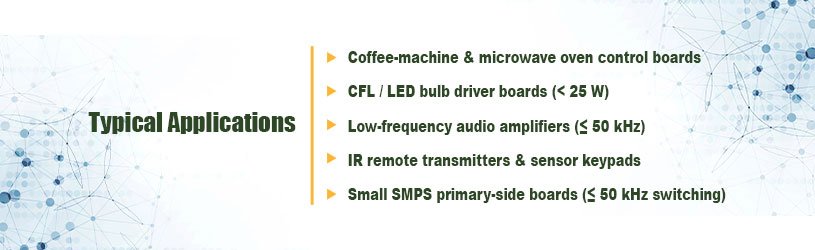
Typical Applications
- Coffee-machine & microwave oven control boards
- CFL / LED bulb driver boards (< 25 W)
- Low-frequency audio amplifiers (≤ 50 kHz)
- IR remote transmitters & sensor keypads
- Small SMPS primary-side boards (≤ 50 kHz switching)
HIGHPCB China pcb manufacturer Located in Shenzhen City, Click on the link for more information.
Manufacturing Workflow (Single-Layer CEM-1)
| Step | Process Note | Best-Practice Parameter |
| Panel CAM | Gerber & netlist DRC, punch-tool map | Min clearance 0.25 mm |
| Drilling / Punching | Use carbide bits for holes < 1 mm; punch larger slots | Hit-rate ≤ 200 hits/bit |
| Copper Patterning | Dry-film or LDI; cupric chloride etch | Min trace/space 0.20 mm |
| Solder Mask | LPI epoxy, UV cure | Mask opening ≥ 80 µm |
| Surface Finish | OSP for cost; Sn > 8 µm for long shelf life | Pb-free HASL only if profile < 245 °C |
| Depanelisation | Steel rule punch or singulation | Burr ≤ 0.05 mm |
| Electrical Test | Flying probe 50–100 pts/s | HiPot 250 V, isolation ≥ 10 MΩ |
Design Guidelines (Engineers’ Quick Reference)
- Board thickness: 1.0 mm (handheld) or 1.6 mm (appliance)
- Copper weight: 35 µm standard; 70 µm for ≥ 2 A traces
- Single-sided PTH: Avoid; if jumpers needed, use solder bridges or rivets
- Min hole Ø (NPTH): 0.80 mm (to suit punch tooling)
- V-cut: 30° blade, residual web 0.25 mm
- Thermal relief: For pads > 3 mm keep spoke width ≥ 0.25 mm to avoid cold joints
Thermal Tip: For LEDs or TO-220 devices, add an external aluminium slug or thick-copper jumper on the component side to compensate for CEM-1’s modest 0.32 W/m·K conductivity.
Comparing CEM-1 vs FR-4 vs Phenolic (1-Layer)
| Metric | FR-4 | CEM-1 | Phenolic |
| BOM cost (relative) | 1.0 | 0.7 | 0.4 |
| Punchability | Moderate | Excellent | Excellent |
| Pb-free reflow | ✔ | Borderline | ✖ |
| Wave solder | Excellent | Good | Fair |
| Mechanical strength | High | Medium | Low |
| UL 94 rating | V-0 | V-0 | HB / V-0 |
CEM-1 delivers the sweet-spot for appliance-grade cost savings without dropping below UL V-0 safety.
Support All Types of PCB Fabrication
Biggest PCB Manufacturers
Material Deep-Dive: Single-Layer Budget Substrates
1 CEM-1 PCB – 1 Layer
- Structure: glass-cloth (copper side) + cellulose paper, epoxy bonded.
- Electrical: εr ≈ 4.5; suitable to ~100 MHz digital.
- Thermal: Tg ≈ 110 °C → wave solder yes; Pb-free reflow marginal.
- Processing: punches cleanly; V-cut 30°; use peelable mask for test pads.
- Use-cases: coffee-machine controllers, CFL/LED bulb drivers, audio amps ≤50 kHz, remote-control keypads.
2 Phenolic PCB – 1 Layer (FR-1 / FR-2)
- Structure: paper core + phenol-formaldehyde resin (SRBP). No glass.
- Electrical: εr ≈ 5.1; good to ~30 MHz analog.
- Thermal: Tg 100 – 105 °C → wave/hand solder only; reflow not recommended.
- Processing: carbide tooling, punch/rout; vias via rivets or jumpers.
- Use-cases: toy circuits, analog TV tuner modules, wall-charger primaries, disposable medical testers.
Design Rules (Cost-Optimised 1-Layer Rigid Boards)
| Parameter | CEM-1 | Phenolic |
| Min track / gap | 0.20 / 0.20 mm | 0.25 / 0.25 mm |
| Min NPTH drill | 0.80 mm | 0.90 mm |
| Copper weight | 35 µm standard | 35 µm (50 µm for >1 A) |
| Board thickness | 1.0 / 1.6 mm | 1.2 / 1.6 mm |
| Max punched panel | 450 × 600 mm | 350 × 450 mm |
Engineering tip: on phenolic boards, keep continuous currents >1 A on ≥2 mm tracks or add external Cu jumpers / Al heat-sinks.
Cost & Performance Snapshot
| Property | FR-4 | CEM-1 | Phenolic |
| Relative cost | 1.0× | 0.7× | 0.4× |
| Punchability | Moderate | Excellent | Excellent |
| Wave-solder survival | Excellent | Good | Fair |
| Pb-free reflow | ✔ | Borderline | ✖ |
| Mechanical strength | High | Medium | Low |
| UL-94 rating | V-0 | V-0 | HB (> some grades V-0) |

Why Source CEM-1 Boards from HighPCB?
- Hybrid tooling – CNC + high-speed steel-rule punch lines for perfect edge finish.
- Process-controlled wave profiles for epoxy/paper laminates (ΔT < 3 °C across panel).
- 3-day quick-turn prototypes; mass production within 7–10 days.
- End-to-end service – stencil, assembly, functional test at IPC-A-610 Class 2.
Ready to slash PCB cost without compromising safety?
Request your instant CEM-1 quotation from HighPCB today and accelerate your next appliance or LED design to market.
FAQ
Is CEM-1 suitable for surface-mount (SMT) parts?
Yes—provided peak temperature stays below ~245 °C and dwell time < 10 s. For lead-free paste, selective-solder or low-temperature BiSnAg alloys are recommended.
Can I plate through-holes on single-layer CEM-1?
Technically yes, but economics seldom justify PTH on CEM-1. Designers usually route jumpers or use solder bridges.
What is the largest panel HighPCB can punch for CEM-1?
Up to 450 × 600 mm with ±0.15 mm dimensional tolerance.
Does CEM-1 meet RoHS and REACH?
All CEM-1 grades we source are RoHS 2 and REACH compliant, free of halogenated flame retardants unless V-0 is required.