


High-Precision, Cost-Optimised Rogers PCB Boards for Robust Electronics

What Is a Rigid PCB?
Rigid PCBs employ glass-reinforced (FR-4), composite (CEM-1), or paper-phenolic (FR-1 / FR-2) laminates that lock into shape once etched; they do not bend after fabrication. The result is dimensional stability, tight layer registration, and excellent production economics for high-volume assembly lines.
Glass-transition temperature Tg
Typical Value : FR-4: 135 – 200 °C† CEM-1: ~110 °C Phenolic (FR-1/FR-2): 100 – 130 °C
Relevance : Determines survivability during lead-free reflow or wave solder
Relevance : Determines survivability during lead-free reflow or wave solder
Dielectric constant εr @ 1 MHz
Typical Value : FR-4: 4.2 (3.7–4.5 range) CEM-1: 4.5 Phenolic: 5.1
Relevance : Affects impedance in high-speed traces
Relevance : Affects impedance in high-speed traces
CTE, Z-axis (below Tg)
Typical Value : FR-4: 50–70 ppm/°C CEM-1: 70–85 ppm/°C Phenolic: 75–95 ppm/°C
Relevance : Lower CTE reduces via barrel cracking
Relevance : Lower CTE reduces via barrel cracking
Thermal conductivity
Typical Value : 0.3–0.4 W/m·K (FR-4, CEM-1) ≈0.25 W/m·K (phenolic)
Relevance : Drives heat spreading from power devices
Relevance : Drives heat spreading from power devices
values are typical — always confirm with laminate datasheets.
† High-Tg FR-4 grades (170 – 200 °C) are mandatory for Pb-free reflow.
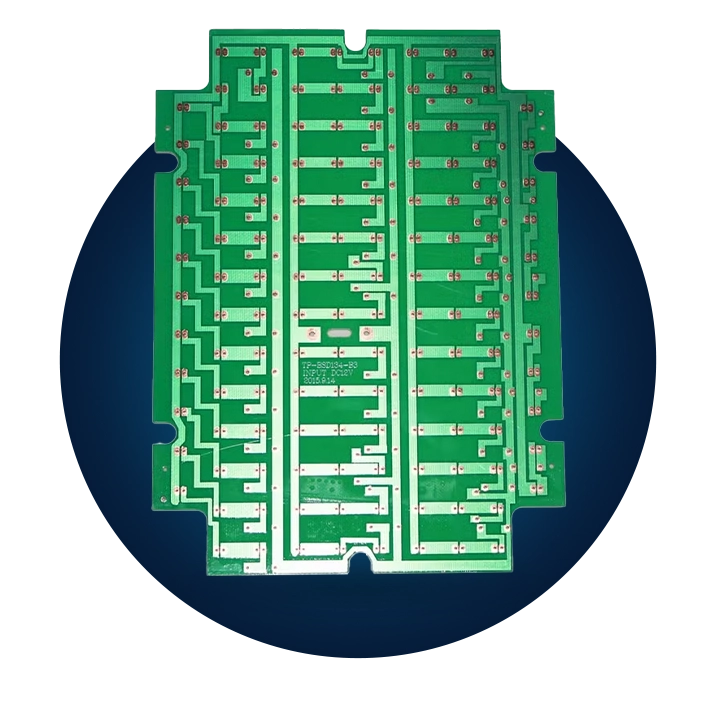
CEM PCB – 1 layer
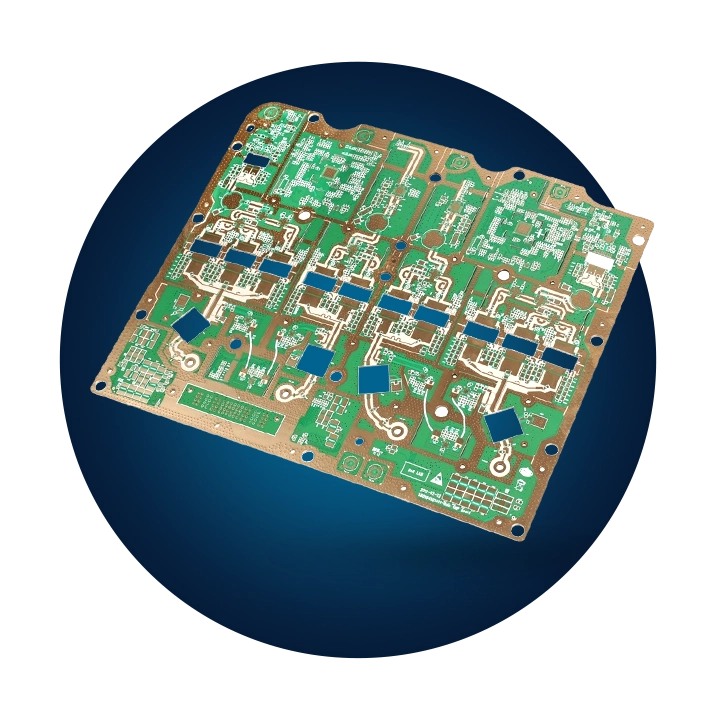
Phenolic PCB – 1 layer
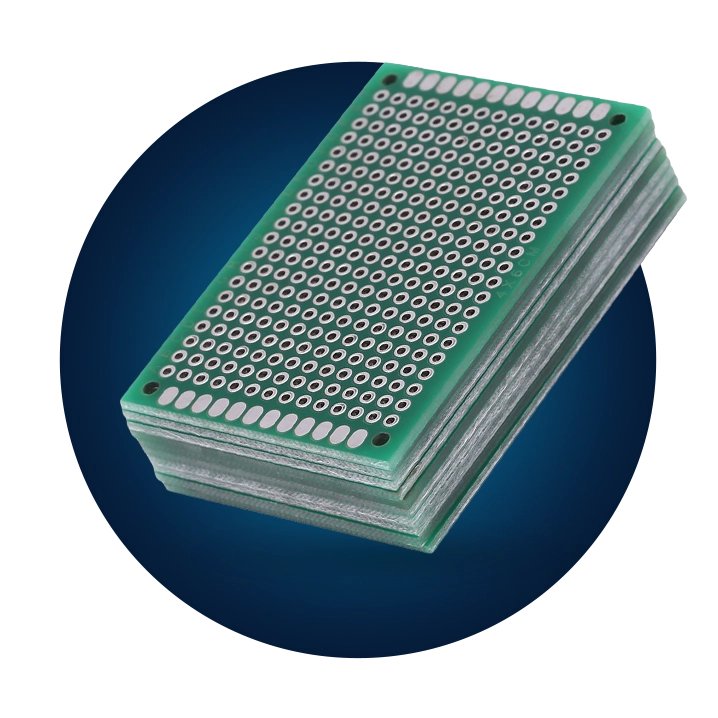
Epoxy PCB
FR1 PCB
FR2 PCB

FR3 PCB
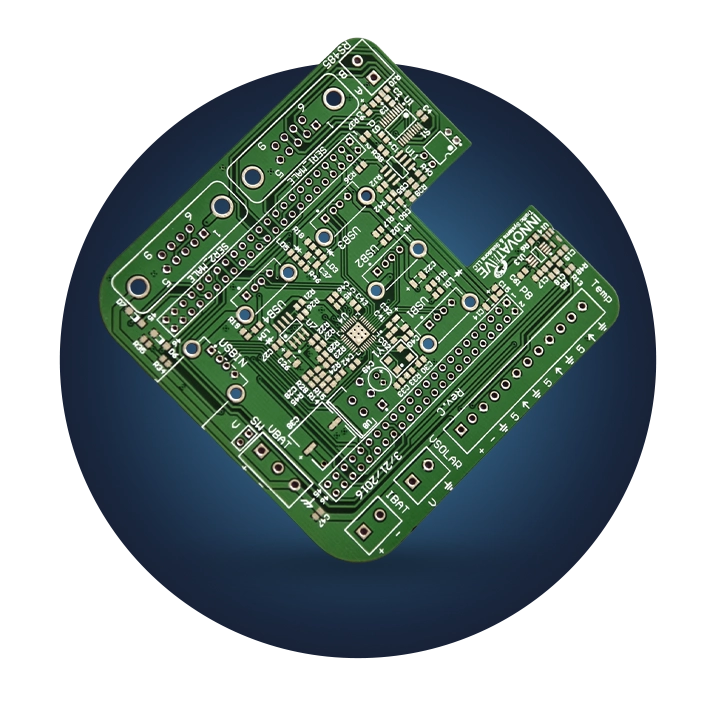
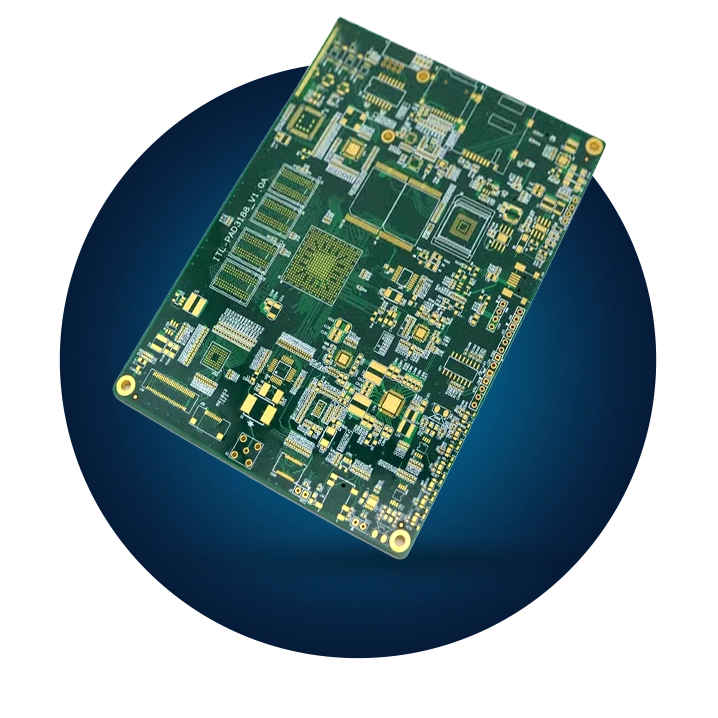
PCB FR4 High TG
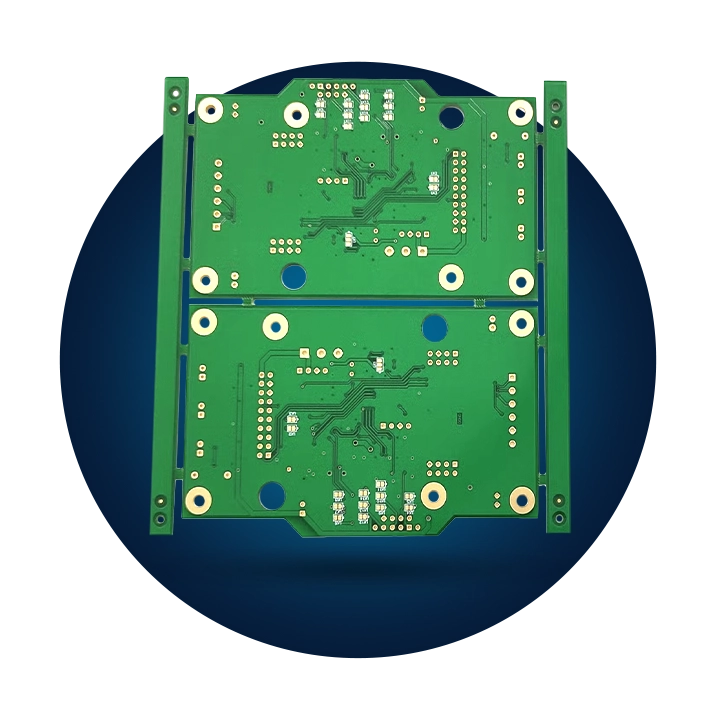

Advantages of Rigid PCB Fabrication
- Mechanical Strength – ideal for heavy connectors, heat-sinks, press-fit pins.
- Cost Efficiency – mature panelisation, automated insertion, no stiffeners.
- Layer Scalability – 1-layer appliance boards through 14-layer server backplanes.
- Material Range – FR-4 mainstream, CEM-1 budget, phenolic ultra-budget.
- Thermal Stability – high-Tg FR-4 endures ≥260 °C reflow; CEM-1 survives leaded wave.
Core Markets
Consumer appliances • LED drivers • Automotive ECUs • Industrial I/O & HMIs • Power supplies • Instrumentation backplanes.
Manufacturing Flow (Rigid Boards)
| Step | Process | Critical Control |
| 1. CAM & panelisation | Netlist compare, impedance modelling | Min annular ring 0.25 mm; aspect ≤ 6:1 |
| 2. Drilling | CNC, entry/exit films | ≤120 k rpm; ≤200 hits per bit |
| 3. Cu deposition (PTH) | 1 µm electroless + 25 µm electro | Dimple < 20 µm |
| 4. Imaging & etch | LDI ≤ 75 µm lines; cupric chloride | Etch factor 3:1 |
| 5. Solder mask / legend | LPI mask, UV cure | Mask clearance ≥ 80 µm |
| 6. Finish | HASL-LF, ENIG, or OSP | Au 0.05 µm ± 0.02 |
| 7. Test & AOI | Flying-probe, X-ray (BGA) | Isolation ≥ 10 MΩ @ 250 V |
Support All Types of PCB Fabrication
Biggest PCB Manufacturers
Material Deep-Dive: Single-Layer Budget Substrates
1 CEM-1 PCB – 1 Layer
- Structure: glass-cloth (copper side) + cellulose paper, epoxy bonded.
- Electrical: εr ≈ 4.5; suitable to ~100 MHz digital.
- Thermal: Tg ≈ 110 °C → wave solder yes; Pb-free reflow marginal.
- Processing: punches cleanly; V-cut 30°; use peelable mask for test pads.
- Use-cases: coffee-machine controllers, CFL/LED bulb drivers, audio amps ≤50 kHz, remote-control keypads.
2 Phenolic PCB – 1 Layer (FR-1 / FR-2)
- Structure: paper core + phenol-formaldehyde resin (SRBP). No glass.
- Electrical: εr ≈ 5.1; good to ~30 MHz analog.
- Thermal: Tg 100 – 105 °C → wave/hand solder only; reflow not recommended.
- Processing: carbide tooling, punch/rout; vias via rivets or jumpers.
- Use-cases: toy circuits, analog TV tuner modules, wall-charger primaries, disposable medical testers.
Design Rules (Cost-Optimised 1-Layer Rigid Boards)
| Parameter | CEM-1 | Phenolic |
| Min track / gap | 0.20 / 0.20 mm | 0.25 / 0.25 mm |
| Min NPTH drill | 0.80 mm | 0.90 mm |
| Copper weight | 35 µm standard | 35 µm (50 µm for >1 A) |
| Board thickness | 1.0 / 1.6 mm | 1.2 / 1.6 mm |
| Max punched panel | 450 × 600 mm | 350 × 450 mm |
Engineering tip: on phenolic boards, keep continuous currents >1 A on ≥2 mm tracks or add external Cu jumpers / Al heat-sinks.
Cost & Performance Snapshot
| Property | FR-4 | CEM-1 | Phenolic |
| Relative cost | 1.0× | 0.7× | 0.4× |
| Punchability | Moderate | Excellent | Excellent |
| Wave-solder survival | Excellent | Good | Fair |
| Pb-free reflow | ✔ | Borderline | ✖ |
| Mechanical strength | High | Medium | Low |
| UL-94 rating | V-0 | V-0 | HB (> some grades V-0) |

Why Choose HighPCB?
- Material breadth: 30+ laminate SKUs, including halogen-free CEM-3.
- DFM expertise: impedance modelling & stack-up optimisation delivered in 48 h.
- Rapid lead time: 3-day quick-turn on single-layer CEM and phenolic.
- Integrated assembly: in-house SMT lines, IPC-A-610 Class 2 certified.
Turn your concept into a robust, production-ready rigid PCB—request a fast, no-obligation quote today.
FAQ
What distinguishes rigid PCB fabrication from flexible PCB fabrication?
Rigid laminates (FR-4, CEM-1, phenolic) remain flat; flex PCBs use polyimide films that bend, enabling dynamic motion but at higher cost per area.
Can single-layer CEM-1 PCBs support SMT?
Yes—provided peak solder temperature stays below ~245 °C and component density is moderate.
Are phenolic PCBs RoHS-compliant?
Modern SRBP laminates meet RoHS 2 and REACH; disposal must avoid uncontrolled incineration.
What is HighPCB’s minimum order quantity for rigid PCBs?
Prototype runs start at 5 panels, scaling to high-volume production.
Epoxy-Based Rigid PCBs
From Low-Cost FR-1/FR-2 to High-Tg FR-4 for Pb-Free Reflow
-
Epoxy PCB Family Overview
Epoxy PCB is an umbrella term for rigid laminates whose binder system is epoxy-based (fully or partially). IPC-4101 groups them as follows:
| IPC slash sheet | Trade name | Core reinforcement | Resin system | Typical Tg |
| /21, /22 | FR-1 | Paper | Phenolic* | 125–135 °C |
| /10, /11 | FR-2 | Paper | Phenolic* | 100–110 °C |
| /12 | FR-3 | Paper | Epoxy | 120–135 °C |
| /126, /130 | FR-4 High-Tg | Glass cloth | Epoxy (enhanced) | 170–200 °C |
* Although FR-1/FR-2 use phenolic resin, they are routinely classified with epoxy boards in low-layer rigid fabrication because the production route is identical.
-
Why Choose an Epoxy-Class Rigid PCB?
| Advantage | FR-1/FR-2 | FR-3 | High-Tg FR-4 |
| Ultra-low BOM cost | ✔✔✔ | ✔✔ | ✔ |
| Punch & V-cut friendly | ✔✔✔ | ✔✔ | — |
| Pb-Free Reflow capable | ✖ | ✖/borderline | ✔ |
| Mechanical strength | Low | Medium | High |
| Thermal robustness | Wave only | Wave/selective | Reflow to 260 °C |
| Layer count | 1-layer | 1–2 layers | 1–16+ layers |
-
Individual Sub-Grades in Detail
3.1 FR-1 PCB — Paper + Phenolic, Tg ≈ 130 °C
- Positioning: Cheapest rigid laminate on the market.
- Electrical: εr ≈ 5.1 (1 MHz), loss tan ≈ 0.03 → fine for < 30 MHz analog, chargers, toys.
- Thermal: Handles Sn-Pb wave solder (< 245 °C, 4–6 s). Pb-free reflow not allowed.
- Processing: One-shot steel-rule punching, NPTH Ø ≥ 0.9 mm, trace/space ≥ 0.25 mm.
- Typical uses: Battery toys, wall-plug chargers ≤ 15 W, throw-away medical strips.
3.2 FR-2 PCB — Paper + Phenolic, Tg ≈ 105 °C
- Difference from FR-1: Slightly lower Tg, lower cost, broader availability in Asia.
- Limitations: Even less thermal headroom; avoid heavy through-hole transformers.
- Ideal for: AM/FM radios, IR remote controls, very low-cost LED night-lights.
3.3 FR-3 PCB — Paper + Epoxy, Tg 120–135 °C
- Upgrade path from FR-2 when you need epoxy bond strength but still want punchability.
- Electrical: εr ≈ 4.8, loss tan ≈ 0.025 — good to ~80 MHz digital clocks.
- Manufacturing perks: Accepts selective Pb-free solder if peak ≤ 245 °C & dwell < 10 s.
- Applications: CFL/LED drivers ≤ 40 W, appliance controllers, budget IoT sensor hubs.
3.4 High-Tg FR-4 PCB — Glass-Epoxy, Tg 170–200 °C
- Key feature: Survives lead-free reflow (JEDEC J-STD-020 up to 260 °C) with minimal Z-axis expansion (CTE ≈ 45–55 ppm/°C).
- Electrical: εr ≈ 4.2 @ 1 GHz, loss tan ≈ 0.015. Impedance-controlled to multi-Gb/s.
- Stack-up versatility: 1- to 16-layer, blind/buried vias, microvia laser drilling.
- Target markets: Automotive ADAS, industrial drives, server motherboards, LED Head-lamps.
-
Manufacturing Flow & Design Tips (Single-Layer Epoxy Boards)
| Step | FR-1 / FR-2 | FR-3 | Note |
| Panel size (punch) | 350 × 450 mm | 350 × 450 mm | ± 0.15 mm tolerance |
| Min trace / gap | 0.25 / 0.25 mm | 0.20 / 0.20 mm | LDI optional on FR-3 |
| Copper weight | 35 µm (50 µm if >1 A) | 35 µm standard | |
| Surface finish | OSP or Sn ≥ 8 µm | OSP / Sn / ENIG | FR-3 can accept ENIG |
| Thermal relief | 4 spokes, 0.30 mm width | 0.25 mm spokes | avoid cold joints |
| Hole plating | not economical | optional, but cost↑ | consider rivets on FR-1/2 |
Power Hint: Combine 70 µm copper + 2 mm trace width to carry 1 A continuous at 25 °C rise on FR-1/2 boards.
-
Epoxy PCB Selection Cheat-Sheet
| Requirement | Recommended Grade | Rationale |
| BOM minimisation, throw-away device | FR-1 | Lowest raw-laminate cost |
| Very thin margins but slight thermal margin | FR-2 | Even cheaper, Tg still > 100 °C |
| Punchability and stronger epoxy bond | FR-3 | Paper-epoxy hybrid |
| Lead-free reflow, multi-layer, high reliability | High-Tg FR-4 | Glass-epoxy, Tg ≥ 170 °C |
FAQ About Epoxy-Based Rigid PCBs
Is FR-3 considered an epoxy PCB?
Yes—FR-3 uses an epoxy resin binder with paper reinforcement, giving better bond strength than phenolic (FR-1 / FR-2) while retaining punchability.
Can I run high-speed (> 100 MHz) digital on FR-1 or FR-2?
Signal loss and dielectric variability make them unsuitable. Upgrade to FR-3 or FR-4.
What high-Tg value should I specify for Pb-free automotive boards?
Select Tg ≥ 180 °C with Z-CTE < 55 ppm/°C to meet AEC-Q100 reflow profiles.
Does HighPCB supply V-0 rated FR-1 / FR-2?
Yes—phenolic V-0 grades are available; add “UL 94 V-0” in the stack-up when requesting a quote.
Why Source Epoxy-Class PCBs from HighPCB?
- Material breadth: FR-1, FR-2, FR-3, CEM-1, standard & high-Tg FR-4 in stock.
- Dual tooling lines: steel-rule punch for paper boards, CNC routing for FR-4 multilayers.
- Quick-turn: 3-day prototypes (single-layer) to 7-day multilayer FR-4.
- Full service: DFM review, impedance modelling, SMT assembly, ICT & functional test.
Need guidance choosing the right epoxy laminate? Chat with our engineers and receive a same-day quotation tailored to your cost, thermal, and reliability targets.